
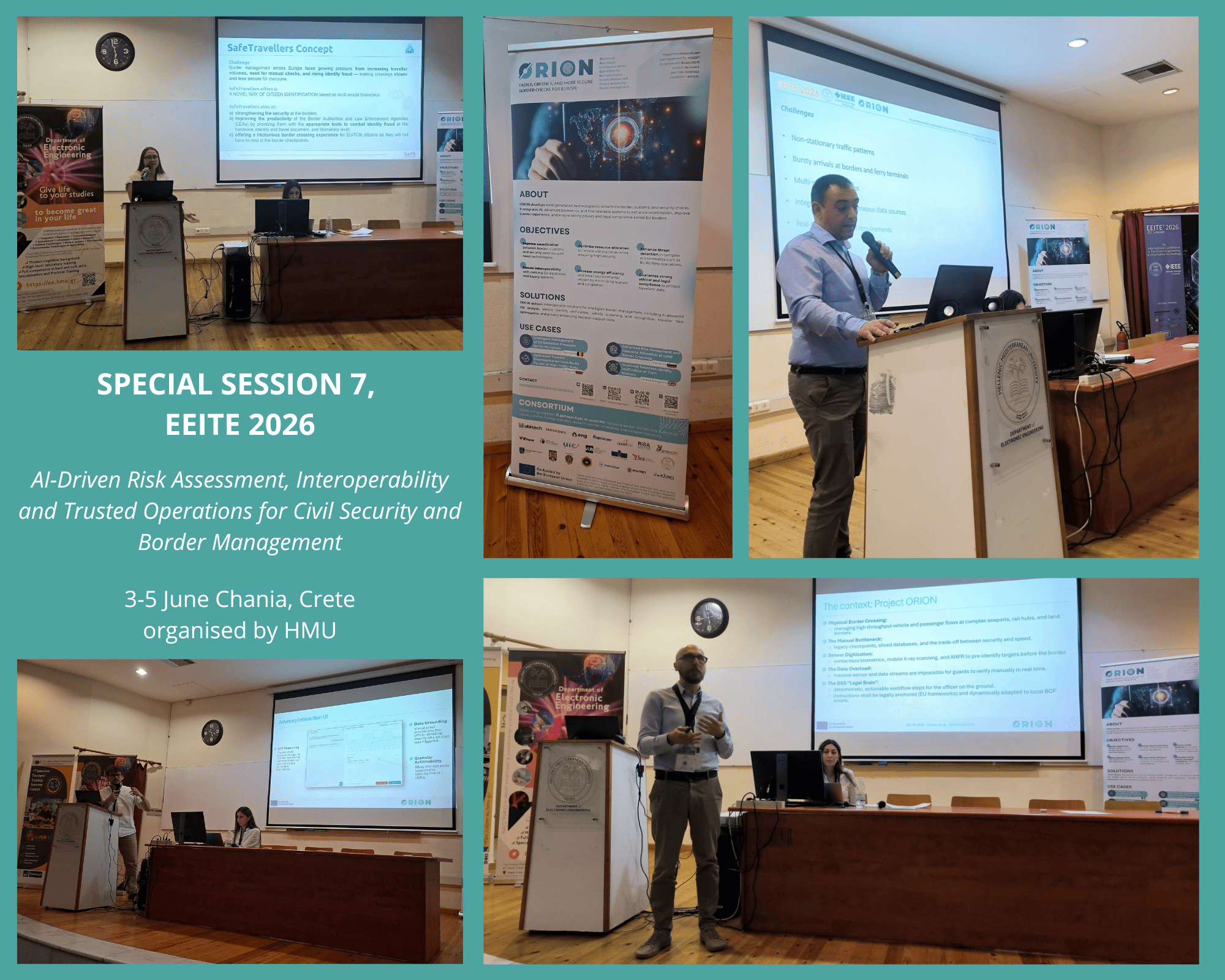
ORION was represented at the EEITE 2026 Conference through the special session 7: AI‑Driven Risk Assessment, Interoperability and Trusted Operations for Civil Security and Border Management, chaired by Mariza Konidi and Aslihan Kağnıcı.
The session brought together ORION partners to present complementary contributions addressing a shared objective: how advanced AI technologies can support border authorities while preserving transparency, accountability and human control.
Predictive and explainable decision support for border operations
Michalis Vourtzoumis (NETcompany) presented “A Human Centric Border Resource Management Framework with Predictive Optimization and Large Language Models.”
The presentation introduced the Border Resource Management System (BRMS) developed within ORION, designed to support border authorities in managing fluctuating traffic, operational constraints and accountability requirements.
BRMS combines predictive models and optimisation techniques to generate real time recommendations for staffing and equipment allocation. Importantly, the system operates strictly in an advisory role: border officers retain full authority over decisions, can accept or reject recommendations through a dedicated interface, and all actions remain traceable and grounded in established procedures.
Anticipating congestion through multi modal AI
Anargyros Baklezos (Hellenic Mediterranean University) presented “A Multi Modal AI Framework for Real Time Queue Prediction, Management and Optimisation in Intelligent Border Control Systems.”
This contribution focused on how multi modal data fusion, combined with LSTM based prediction and optimisation techniques, can help anticipate congestion and support proactive traffic management at border crossings.
By integrating heterogeneous inputs, such as historical traffic patterns, vehicle data, pre registration information and environmental conditions, the framework moves beyond static or rule based approaches. Experimental evaluations using pseudo realistic data illustrate how predictive AI can contribute to reduced waiting times, increased throughput and more resilient border operations, both at land borders and ferry terminals.
Ensuring trust when using generative AI
Marco Paleari (Engineering) presented “Towards a Hybrid Graph RAG and Policy Enforcement Architecture for Explainable Border Control Decision Support Systems.”
The presentation addressed a key concern in regulated and high stakes domains: how to use large language models without the risk of hallucinations or non compliant outputs.
The proposed hybrid architecture separates decision making from language generation. Deterministic policy enforcement mechanisms ensure compliance with legal and operational rules, structured knowledge models support contextual reasoning, and retrieval augmented components ground outputs in verified sources. The language model is used only at the final stage to generate human readable explanations, ensuring recommendations remain explainable, verifiable and under human control.
From pilots to practice: SafeTravellers and transferable lessons for ORION
The session also featured “SafeTravellers: Pilot Validation Campaigns, User Acceptance and Transferable Lessons for Next Generation Border Management,” presented by Paula Fernández Díaz (UIC).
The presentation focused on the role of pilot validation and user acceptance in the deployment of innovative border technologies. SafeTravellers addresses key challenges faced by border authorities today, including increasing traveller volumes, time consuming manual checks and rising identity fraud.
To assess solutions in realistic conditions, SafeTravellers implemented four pilots covering air, sea, land and rail transport, each targeting different operational risks. Particular attention was given to the rail pilot, led by UIC, which explored how identity checks could be performed inside trains using lightweight mobile devices.
The pilot tested the full end to end process, from traveller registration and digital identity creation to QR code exchange and biometric verification, in a simulated train environment. Results from Phase 1 showed that mobile biometric checks can be completed in around 30 seconds, with high levels of user acceptance. Travellers appreciated the simplicity and comfort of the process, while border experts provided valuable feedback to refine technical and usability aspects.
These pilot activities provide concrete, transferable lessons for ORION:
- Mobile and flexible border checks are feasible, even in constrained environments such as trains
- Biometric verification can be both fast and reliable
- User acceptance is high when solutions are intuitive and minimally intrusive
SafeTravellers therefore contributes not only validation results, but also practical insights that directly inform ORION’s risk based and intelligence driven approach to border management.
Advancing responsible innovation in border management
Together, the EEITE 2026 Special Session 7 contributions demonstrated ORION’s integrated vision: combining predictive AI, optimisation, interoperability and explainable decision support, while embedding ethics by design, privacy by design and human in the loop principles.
As ORION progresses, these concepts will continue to be refined through close collaboration with end users and future pilot activities.